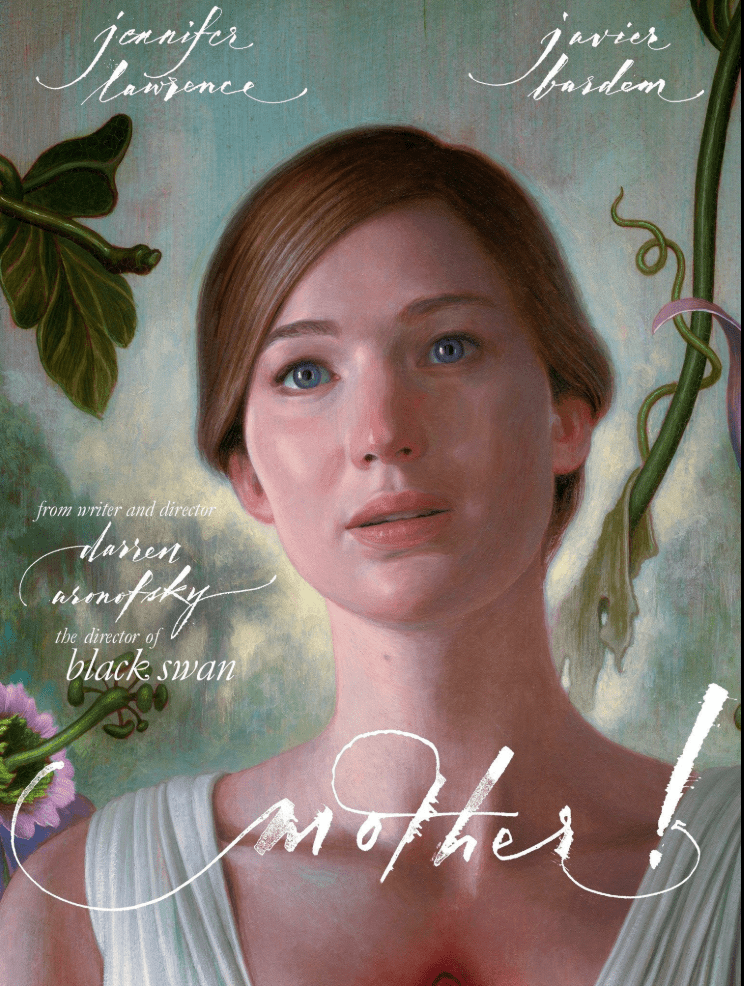
Darren Aronofsky’s mother! (2017) is a film that strived for artistic depth but ultimately collapses under the weight of its own ambition. It’s marketed as a psychological horror, but that would only ring true if the audience is strictly women, as all of the psychological damage happens to our perfect female protagonist. The film quickly abandons traditional storytelling in favor of innumerable allegories and graphic and chaotic symbolism. The hyperbolic elements that adorn every aspect of the storytelling reduce the moments to mere spectacle while hiding the weaknesses in the narrative. The film bombards viewers with unwavering intensity, not allowing for genuine suspense or any connection, which is a foundation necessary for effective storytelling. As a result, mother! feels like the most disjointing, fever-dream-like singular experience whose shortcomings fall on the erratic pacing, a lack of character motivations, and over-reliance on symbolism, culminating in an exhausting two hours and one minute.
The film follows a young woman called Mother living in a very secluded house with her husband, Him, who is a poet. As she renovates their home from what the audience learns was a house fire, many unexpected guests start to arrive, starting with a mysterious and secretive man who later invites his sexually provocative wife. These first uninvited guests serve as representations of Adam and Eve, as Man has an illness which is later to be discovered as cancer, and a contusion on his back rib cage. They invade Mother’s home, are unruly house guests, invade their privacy, and set up the story for the eventual chaos. The next characters to arrive are Man’s and Woman’s sons, who are set up to represent Cain and Abel. Due to the understated context surrounding the father’s will, The Brothers show up at Mother’s house and start fighting with one another until one gets murdered in a jealous rage. The violence that occurs in the house is just foreshadowing the destruction and violence that consumes Mother’s home throughout the film. As the poet’s fame grows, crowds of worshippers flood into the house, turning it into a literal war-torn battlefield. The followers of Him possibly symbolize the dangers of blind faith and fanaticism, showing how, ultimately, people destroy what they idolize, but there is no real action that grants the audience comprehension. What Aronofsky loses in plot points, he makes up in cinematography for the intense and flawless transitions throughout the house as it morphs and changes into a nightclub, to a battlefield, to a refugee camp, and finally into a complete shrine at the end.
The film makes use of the obscure nature of the setting. Aronofsky’s decision to forgo a soundtrack leaves the film feeling stark and at times hollow. It is oddly quiet with minimal sounds of nature, but the foley is too loud in comparison to the action and mood of the scenes. Even in actions as simple as walking barefoot down the stairs, the booming sound of Mother’s feet feels out of place for the setting of a beautiful country home at daybreak. This choice may have been intended to enhance realism and unease, but ultimately is contributes to the alienating aspect of the film, further driving a wedge between the audience and connecting with the already disjointed material. Without a score, mother! Relies solely on sounds like creaking floorboards, sudden noises, and murmured dialogue to create tension and suspense. The overwhelming sensory assault in this film leaves little room for emotional nuance, which is executed by acting and directing, but bolstered by intentional sound design or scoring. This makes it difficult to track the tonal shifts and changes in moments of chaos where the audience cannot rely on the actors for context.
In the most horrifying and objectively most unnecessary scene in the film, Mother and Him’s newborn baby gets passed around as the metaphorical Jesus the Messiah is viewed by the people. As the baby is crowd surfing through Him’s followers moments after his birth and against Mother’s will, we hear an unfortunate and deafening crack. Unsurprisingly, the baby’s neck snaps, resulting in his death. The followers in the house then recite the same eulogy that they gave for the brother who passed early in the film before proceeding to cannibalize the child’s remains (eating the body of Christ). This sequence marks a moment where Aronofsky’s portrayal of women becomes troubling. In an act of sheer brutality, Mother is being viciously assaulted while gendered, pointed slurs are being screamed at her. The extended nature of this scene, combined with its relentless violence for the sake of the story, raises questions about the film’s treatment of its female protagonist and whether it respects or values its female lead beyond her suffering.
Unfortunately, this film never leaves the viewer satisfied. Nothing you want to happen happens, and if it does, like people leaving the house for example, it’s short-lived. I suppose it could reflect the frustration that our ‘creators” or Mother Nature feels, but it leaves for an unpleasant viewing experience. Sometimes a film can get lost in its own plot, in its own writing and then you lose the story completely which is exactly what is happening here.
While the film attempts to weave biblical, environmental, and existential themes into a psychological horror formula, mother!’s abstract storytelling and chaotic structure make it a frustrating, rather than compelling, experience. Despite the narrative shortcomings, the film is technically executed well. Aronofsky’s direction creates an unrelenting sense of malice and claustrophobia, while the adaptive POV style cinematography immerses the audience in Mother’s world. With Jennifer Lawrence’s raw and emotionally charged performance and Javier Bardem’s self-centered and detached personification of the character Him, the film’s visual style and immersive (yet erratic at times) camera work translate the artistic passion behind the film, even if the story itself fails to engage.
 tai's media mind